Medicine
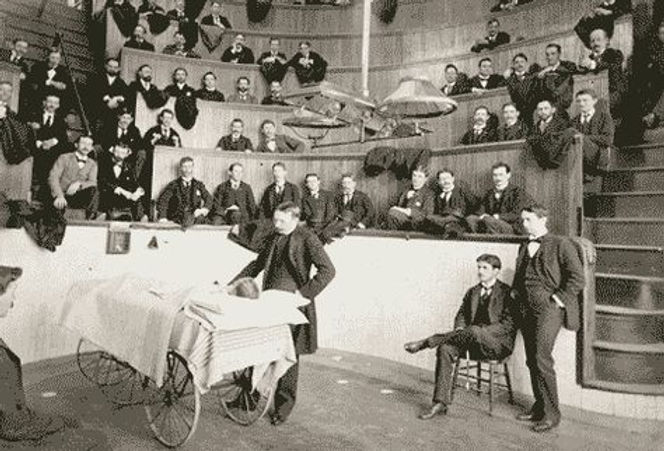
Featuring a photo of a historical operating theatre
Midwife vs. Physician
The practice of midwifery was largely unchanged until the late 19th century. Delivering babies became a medical specialty called the field of obstetrics. Male physicians introduced new techniques that interfered with the normal birth process and competed with midwives, who struggled to hold onto their profession and advance through education. Some midwives became fearful of the competition and spoke out vehemently against physicians.
The advent of anesthesia administered for pain in childbirth became desirable for many women who chose physicians as their birth attendants. American midwives began to clamor for more education, but obstetricians fought hard against them. Schools for midwives were established in European cities, and European health care created a dual system by which midwives continued to attend normal births while physicians handled those with complications. This did not happen in the United States. American physicians fought hard against midwifery education, although it was strongly supported by public health reformers. The next major push by American obstetricians was to move all births from homes to hospitals, where midwives were forbidden to practice. In 1900, over 90 percent of all births occurred in the mother’s home. But by 1940, over half took place in hospitals and by 1950, the figure had reached 90 percent.
Operating Theaters
Operating theatres did not look how it appears in the play. They were designed in an amphitheater fashion to be able to watch surgery for entertainment. These rooms were typically in hospitals. Most operating rooms were essentially amphitheaters and sometimes allowed as many as 450 people to view operations taking place in hospitals. After the development of anesthesia in the 1840s, the disturbing screams of pain associated with surgery were silenced, and more people started attending surgical demonstrations, which no longer displayed patients suffering. Surgical demonstrations really took off as a form of entertainment in the 1870s and ’80s, so much that some hospitals totally re-vamped their theaters to appeal to the wealthy individuals viewing the operations. These rooms were typically in hospitals.
Catching a Cold
In the eighteenth century catching cold was linked to climate. In his popular work Domestic Medicine (1772 edition) William Buchan explained that catching cold was a result of ‘obstructed perspiration’ and that the secret to not getting sick was avoiding extremes in temperature. Buchan observed that ‘the inhabitants of every climate are liable to catch cold, nor can even the greatest circumspection defend them against its attacks’. For treatment, Buchan advised rest, fluids, light foods, and an infusion of balm and citrus. He also cautioned that ‘Many attempt to cure a cold, by getting drunk. But this, to say no worse of it, is a very hazardous and fool-hardy experiment.’ The dispute about whether cold causes colds stems from scientific debates in 19th-century France, LaGreca notes. For Louis Pasteur, who promoted the idea of germ theory in modern medicine, the virus was primary. However, Pasteur’s contemporary, Claude Bernard, argued that infections hinge not on microbes, but on environmental conditions that allow microbial invaders to flourish. In the 20th century, scientists overwhelmingly supported Pasteur’s position. They focused on the pathogen as the root of illness and relied exclusively on microbe-destroying medicines—like antibiotics—for treatment.
Cholera
Cholera (Vibrio cholerae) is an acute infection of the bowel with profuse watery diarrhea and vomiting, causing severe dehydration. A person may contract cholera by drinking contaminated water, milk or by eating contaminated food. Because of the poor or non-existent sanitation excreta from infected people was often dumped into the water supply. Cholera reached New York harbor in 1832. It spread throughout the US via the transportation system of railways, canals, and steamboats. Cholera was variously referred to as Cholera Morbus, Choleric Fever or Dysentery on death certificates.
Cholera Infantum (or summer diarrhea of infants) was a major cause of infant death in the late 1800s. The term cholera described the symptoms that the infant experience. Cholera Infantum is distinct from the epidemic cholera described above. It was a non-contagious disease of young children who had been weaned from the breast. It occurred chiefly between the months of April and October. Cholera Infantum was also called summer complaint, water gripes or weaning brash on the death certificate.
Breastfeeding and Religion
The impact of the Reformation in Europe permeated Puritan theology and manifested in sermons devoted to the ‘evils’ of non-breastfeeding mothers. These sermons taught that non-breastfeeding mothers who chose to hire a wet nurse were selfish and classified their reasons for not nursing as such, minimizing those reasons to: a desire to maintain a social life, preference for non-restrictive clothing, and a lack of love for both her child and God. Breastfeeding had become a religious duty.